If AI Writes Your Book, Do You Own It?
It’s never been easier to write a book fast.
Generative AI has brought with it the ability for authors to generate ideas, create outlines, and even draft entire chapters in minutes. With some focus and the right prompts, an aspiring author can sit down and have an entire manuscript first draft in less than a day. Whether it’s a “quality” product is the topic of another post for another day. Whether you actually need to write your book in a day is another (because, why? But I digress…). In any case, the ability to publish quickly can be exciting from a productivity standpoint and even more enticing when it comes to profitability.
But it introduces a muddy intersection for creators like me, who work closely with authors and entrepreneurs looking to profit from their writing. Because while everyone is debating about whether or not it’s truly creative or even ethical to write your book with AI, the question most folks aren’t asking– at least not very loudly–is whether or not your AI-assisted book is even yours in the first place.
In other words, are books created using AI protected by copyright law?
I imagine that the topic tends to fly under the radar because it isn’t a fun conversation. Being the one to raise your hand and say “But have you thought about…” after someone’s raving about a dream machine that can siphon your thoughts directly out of your head onto the page without any heavy lifting doesn’t exactly help you win any popularity contests. Popular, however, isn’t my thing, and in independent publishing, one of the principles I talk about often, and one that I’ve built my work on top of, is ownership. You need to understand who owns your work and what rights you control, whether you’re publishing traditionally or independently. The introduction of AI adds another layer to the ownership conversation.
If you use AI to create your book, do you actually own it?
The answer, according to the U.S. Copyright Office, is a little like a 2007 Facebook relationship status:
It’s complicated.
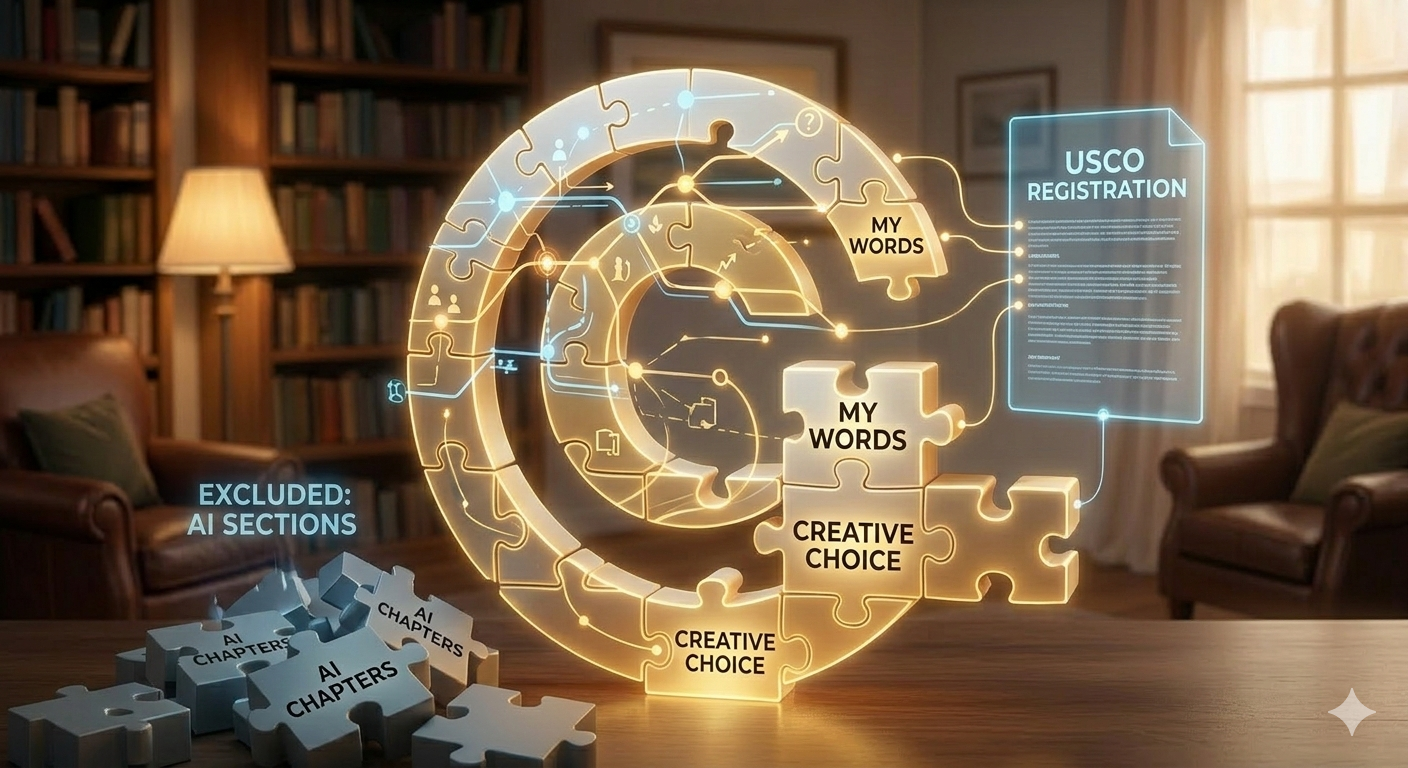
In 2025, the U.S. Copyright Office published its Report on Copyright and Artificial Intelligence, Part 2: Copyrightability, the second report in a three-part series examining how copyright law applies to works created with generative AI. I spent some time going through it so that authors experimenting with AI tools can better understand what it means for their work, because whatever you decide to do, it’s important to understand the implications.
One thing that is clear from the many responses in the 50-plus-page document is that AI use in writing is not automatically illegal or uncopyrightable, but the question isn’t whether AI was used to assist in creating a book. The question is how much of the work was actually created by a human.
My two key takeaways from the document:
A work entirely generated by AI can’t be copyrighted.
If a work has been generated with AI as an assistant, the extent to which it can be protected varies based on the creator's involvement.
*Disclaimer:* I am not an attorney. This article is intended for informational purposes and should not be considered legal advice.
The Core Rule: Copyright Requires Human Authorship
U.S. copyright law protects human creativity. That’s the simple legal principle at the center of the entire conversation.
The Supreme Court defines an author as “the person who translates an idea into a fixed, tangible expression entitled to copyright protection.” In other words, copyright protects the expression created by a human mind, not the idea itself, or the tool used to produce it. That distinction becomes important when technology enters the creative process.
Writers have always used tools to help create their work. Word processors replaced typewriters. Spellcheck replaced dictionaries. Editing software helps us refine language and structure. Even a pen and paper is a technology upgrade from writing on cave walls with berry juice. None of those tools changes the “author” because the creative expression still originates from a human being.
But generative AI complicates that definition because, instead of simply acting as a tool to help refine expression, it can generate expression itself. That’s where the law draws a (wavy) line.
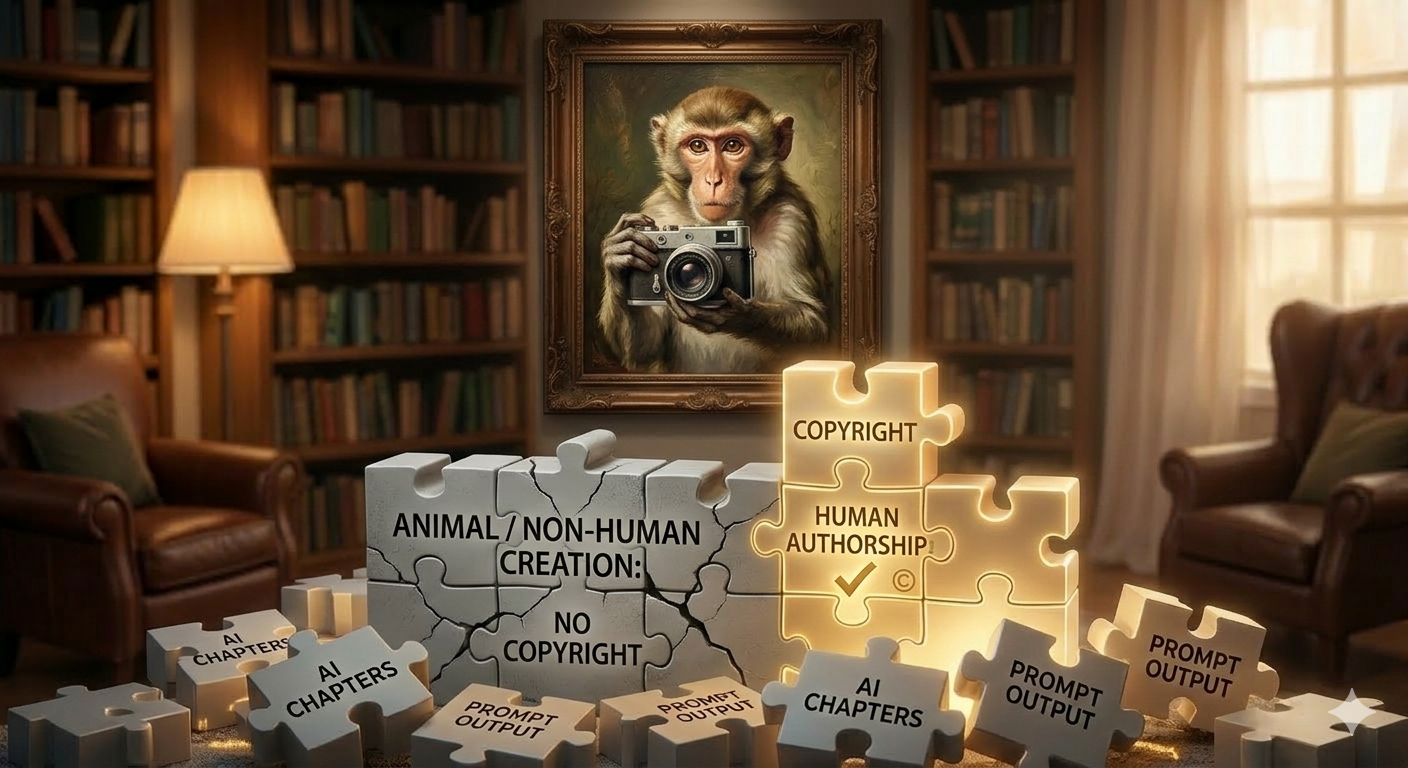
U.S. courts have consistently rejected the idea that something created by a non-human can be protected by copyright. One of the more famous examples is the so-called “monkey selfie” case (Naruto v. Slater), in which a macaque managed to snap a photo using a photographer’s camera. The court ultimately ruled that the monkey could not own the copyright because copyright law applies only to human authors. More recently, courts have applied the same reasoning to AI-generated works. In Thaler v. Perlmutter, a federal court upheld the U.S. Copyright Office’s decision to deny copyright protection to an image that had been described as “autonomously created by a computer algorithm.” Because the applicant acknowledged that no human had played a creative role in producing the image, the court concluded it did not meet the basic requirement of human authorship.
In its report, the USCO goes on to state that, “No court has recognized copyright in material created by non-humans, and those that have spoken on this issue have rejected the possibility.”
Translation: Copyright protects expression created by a human author. It does not protect the output of a machine.
That doesn’t mean AI can’t be used in the writing process, but to fall within the guidelines, it must be used as a tool, not the originator of the idea. So, if you use AI to help write your book, how much human involvement is enough?
To answer that, it helps to think about AI use on a spectrum.
The Spectrum of AI Use in Writing
In practice, most authors don’t fall neatly into one category when they use AI. Instead, the way AI shows up in the writing process tends to exist on a spectrum from light assistance to near-total automation. Where your work falls on that spectrum can influence how much of it is considered human authorship and, therefore, how much of it can be protected by copyright.
1. AI as a Brainstorming or Planning Tool (Low Risk)
At the lighter end of the spectrum, AI functions more like a creative assistant than a creator.
Authors might use it to:
brainstorm ideas
generate potential titles or themes
outline chapters
research or summarize background information
organize a book’s structure
In these situations, the AI output often serves as inspiration or scaffolding, but the actual writing, such as the sentences, arguments, storytelling, and expression, comes from the human author. The U.S. Copyright Office specifically notes that using AI in this way does not affect the copyrightability of the final work. If you’re simply using it to spark ideas or help organize your thinking, it’s not much different from bouncing ideas off a colleague or referencing a research assistant’s notes.
Author takeaway:If you’re using AI for brainstorming or outlining, your copyright is not threatened.
2. AI as a Drafting Assistant (Gray Area)
Things become less clear when AI begins to generate actual text that ends up in the book.
For example, an author might:
Ask AI to draft paragraphs or sections
Use AI-generated text as a starting point and then edit it heavily
Generate multiple versions of a passage and rewrite one of them
Incorporate AI output into a larger human-written manuscript
Here, the key issue becomes how much human creative control is present in the final work. The USCO explains that copyright can still exist where human contributions are perceptible in the final output, for example, if the author meaningfully modifies, rewrites, or creatively arranges the material. In other words, the question becomes less about whether AI was used and more about who actually shaped the expression that ended up on the page.
Authors working in this gray area should probably ask themselves a few honest questions:
Did I substantially rewrite the text?
Did I control the voice, tone, structure, and storytelling?
Or did the AI produce most of the wording that appears in the book?
If the AI-generated text is simply raw material that gets reshaped by a human writer, copyright protection may still apply to the human-created portions of the work.
3. AI as the Primary Writer (High Risk)
At the far end of the spectrum is the workflow that’s currently being marketed most aggressively online:
“Write my book based on this prompt.”
generating entire chapters with AI
selecting the best output from multiple AI drafts
publishing the result with minimal editing
This is where things start to get legally shaky.
According to the USCO, prompts alone do not constitute authorship because the user is providing instructions or ideas, not actually controlling how those ideas are expressed. Even detailed prompts don’t necessarily change that analysis. The AI system still determines the specific wording, phrasing, and structure of the output. Similarly, simply choosing one output from several AI-generated options doesn’t count as authorship either. The USCO compares this kind of selection to curating options rather than creating original expression.
Put plainly:
If AI wrote the words and you simply picked the best version, the law may not recognize you as the author of that text.
Why Following Prompts Is Not the Same as Writing
Before we go any further, it’s worth addressing one of the more popular trends circulating in the online publishing space right now: the promise that you can write your entire book in an hour/weekend/day by following a specific set of prompts.
The average self-help book is somewhere between 40,000 and 60,000 words. As someone who has been writing professionally for two decades, and can do so pretty quickly, the idea that someone can generate a full manuscript in a single day that meaningfully reflects human authorship is, at best, optimistic. At worst, it’s a workflow that raises real questions about whether the final product qualifies for copyright protection at all.
The issue comes down to something the U.S. Copyright Office makes very clear in its report: prompts are not the same thing as authorship.
A lot of people understandably push back on that idea. The argument usually sounds something like this:
“But I wrote a very detailed prompt.”
Maybe you did. Maybe you described the tone, themes, audience, and structure you wanted. Maybe you even refined the prompt multiple times until the AI produced something you liked.But according to the USCO, that still doesn’t necessarily make you the author of the resulting text.
Prompts function primarily as instructions or ideas, and copyright law does not protect ideas. It protects expression, which includes the specific words, phrasing, structure, and creative choices that bring those ideas to life, in this case, on the page. In the case of generative AI, it’s the system, not the user, that determines how those ideas are ultimately expressed. The report explains that even detailed prompts do not provide sufficient control over the expressive elements of the output. In fact, revising prompts repeatedly doesn’t change the analysis much either. From a legal standpoint, each new prompt simply causes the system to generate another output from which the user can choose.
In other words, you’re essentially rolling the dice again until you get something you like. Selecting an AI-generated result from several options may feel creative, but legally speaking, the USCO says it’s closer to curation than authorship.
An analogy: Imagine commissioning a painting. You might give the artist detailed instructions about the subject, mood, and colors you want. You might even ask for revisions until it feels right. But are you the artist, or is it the person actually painting the canvas and making the expressive decisions about brushstrokes, composition, and detail?
I write children’s books and work with an artist to create the illustrations. I give detailed instructions based on the story and the vision I have for the characters. My amazing illustrator always creates a design in line with my vision. But my providing her with detailed prompts about the direction of the images does not, in turn, entitle me to take illustrator credit.
The same principle applies here. Giving instructions, even very detailed instructions, is not the same thing as creating the expressive work itself.
And that’s why workflows that rely almost entirely on prompting AI to generate large portions of a book start to drift into risky territory when it comes to copyright.
What Can Still Be Copyrighted in AI-Assisted Work
The guidance isn’t anti-AI. In fact, the report acknowledges that technology has always played a role in creative work and that AI can absolutely function as a tool within a human-led creative process. The key distinction is that copyright protection attaches to the human contribution. In other words, if a work includes AI-generated material, the parts of the work that reflect human authorship can still be protected.
According to the USCO, these can include several types of contributions:
Human-written portions of the work. If an author writes portions of the manuscript themselves, even if other parts were generated with AI, those human-created sections are still eligible for copyright protection.
Creative selection, arrangement, or organization. Even when AI-generated material is present, an author may still exercise creativity in how that material is structured. The way chapters are arranged, ideas are sequenced, or passages are combined can itself reflect human authorship.
Human content embedded in AI output. If an author inputs their own original writing and that expression remains visible in the final output, that portion remains theirs.
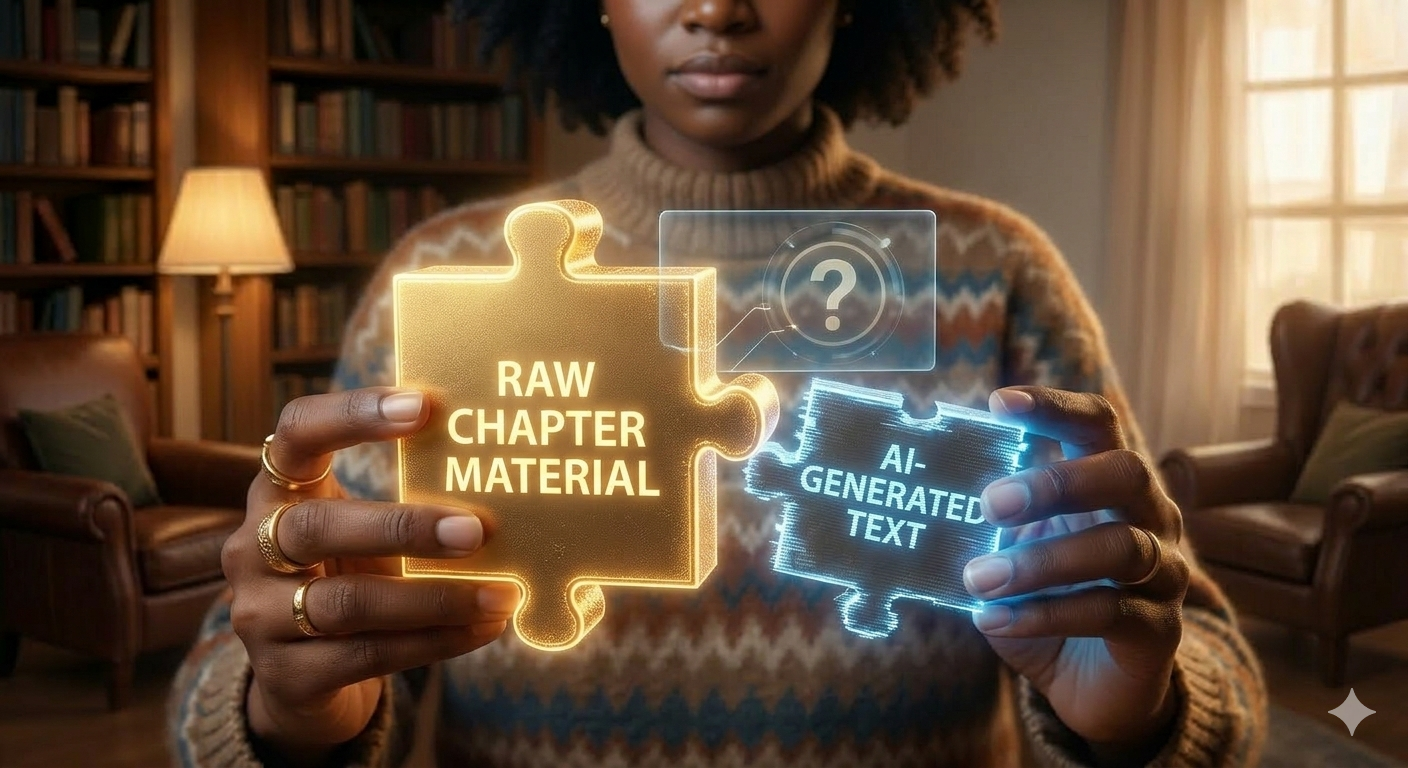
Substantial creative modification. This is where many authors using AI may still fall safely within the boundaries of copyright protection. If AI generates rough text but the author significantly rewrites, restructures, and edits it so that the final work reflects their own voice and creative decisions, the resulting expression may qualify as human authorship.
Think of AI output as raw material rather than finished work.
The Practical Implications for Authors
So what does all of this actually mean for writers who are experimenting with AI tools?
Ownership
If large portions of a book are generated by AI with minimal human involvement, you may not fully own those sections of the work in the way you think you do. Copyright law protects human expression. If the expressive text was primarily generated by a machine, the legal claim to authorship becomes much weaker. That doesn’t necessarily mean the work can’t be published. But it does mean the scope of what you legally control and what you can enforce may be limited.
For authors whose goal is to build intellectual property, license their work, or generate income from it over time, that distinction matters.
Registration disclosure
The USCO has also made it clear that authors are expected to disclose AI-generated material when registering a work for copyright if it contains more than a minimal amount of machine-generated content. Registration applications now ask authors to describe the human contribution to the work and identify any portions generated by AI. In practice, this means that if a manuscript includes AI-generated sections, those portions may be excluded from the copyright registration, while the human-authored portions remain protected.
Publishing implications
This conversation is also prevalent in the traditional publishing industry. Many traditional publishers are including clauses barring authors from including generative AI in their manuscripts. While policies are still evolving, it’s reasonable to expect that transparency around AI use will become more common, particularly as publishers and platforms try to understand the ownership implications.
Future legal uncertainty
Perhaps the most important thing to understand is that the USCO has not drawn hard lines around these questions. Instead, the report emphasizes that determinations about copyrightability will often need to be evaluated on a case-by-case basis, based on how a work was created and what role the human author played in shaping the final expression.
In other words, there are still plenty of gray areas.
My Advice to Authors: Use AI Carefully
AI is a powerful tool, but it shouldn’t replace your authorship. Used thoughtfully, AI can absolutely support the writing process. Things start to get problematic when AI shifts from being a tool in the process to being the primary creator of the work.
If you’re experimenting with AI in your writing, uses like brainstorming ideas, generating possible titles or themes, outlining chapters, researching, and organizing information are generally safe. In these cases, AI is functioning much like a research assistant or creative sounding board. The author is still doing the work of shaping the narrative, choosing the words, and building the ideas into a finished piece.
Where I would urge authors to slow down is with workflows that rely heavily on AI-written chapters, AI-generated books, minimal editing of machine-generated text, and prompt-to-publish approaches that prioritize speed over authorship.
The Bigger Picture
By now, you may be thinking:
Why should I actually care about any of this?
It’s a fair question. The reality is that the odds of your book’s copyright being formally challenged are probably pretty slim. Even if someone wrote a book entirely by following a series of prompts, it’s unlikely that the issue would ever rise to the level of a legal dispute. The truth is, whether you approach AI “the right way” or the “wrong way,” you will probably get away with it.
Large companies like Amazon already ask authors whether their books are AI-assisted, but that information isn’t made public. Their goal is to sell more books, so they aren’t in the business of creating obstacles to that process. The same dynamic exists in many corners of the publishing ecosystem. Courses and coaching programs promise fast-track publishing workflows, often skimming past the ownership question because, practically speaking, it rarely becomes a problem.
But that framing misses the real issue. The bigger question isn’t whether you can get away with it. The bigger question is whether your intellectual property is worth gambling with.
Your ideas, insights, lived experience, education, and everything you’ve learned and built up to this point provide the raw material of your writing. For many authors, that intellectual property is one of the most valuable assets they own. It’s the foundation for speaking engagements, consulting, teaching, licensing, and future books. When you publish a book, you’re building a piece of intellectual property that can create opportunities and income for years. While AI can absolutely accelerate creativity and make parts of the writing process easier, it shouldn’t replace the creative mind behind the work.
The USCO also raises a broader concern that sits quietly beneath all of this legal analysis: the potential impact of AI-generated content on human creators. Copyright law was originally designed to encourage creativity by protecting the people who produce it. If the balance shifts too far toward automated production, that goal becomes harder to maintain.
The USCO notes, “If authors cannot make a living from their craft, they are likely to produce fewer works. And in our view, society would be poorer if the sparks of human creativity become fewer or dimmer.”
Technology will continue to evolve. The law will evolve along with it. Courts and policymakers will keep trying to draw clearer lines around these questions as new tools emerge and creative workflows change. For creators, the best approach right now is awareness. Understanding how authorship and ownership work and how those boundaries may shift is part of protecting the work you create.
If you’re working on a manuscript and want help shaping it into a strong, human-centered book, you can learn more about my editing services here: https://www.ajadorseyjackson.com/editing
Aja Dorsey Jackson is a publishing strategist and editor who helps authors turn their ideas into books and intellectual property.